11th May 2026 By Contributor
Destination Queenstown and Lake Wānaka Tourism CEO Mat Woods makes the case for tourism’s electric future.

The tourism sector has always been adaptive and innovative. However, in recent years we have been tested with the pandemic and now a fuel crisis.
How do we build a tourism sector that is more resilient to disruption, more profitable and built for long-term success?
That question sits at the heart of Electrify Queenstown 2026 and is one which many businesses are again grappling with, as the cost of imported energy rises due to the conflict in the Middle East.
Our award-winning three-day event gets underway on Sunday (17 May), bringing together government ministers and party leaders, international innovators, renewable energy experts, tourism businesses and residents to explore how electrification can cut costs, lift productivity and build a more self-reliant energy system for the Southern Hemisphere’s premier four-season destination, and for the country as a whole.
Now in its third year, Electrify Queenstown can trace its origins back to the last major shock for our industry: the Covid-19 pandemic. Supported by the Strategic Tourism Assets Protection Programme (STAPP) initiative, Destination Queenstown and partners developed our Destination Management Plan (DMP), Travel to a Thriving Future.

Electrify Queenstown is a direct output of the DMP, a key project as we announced our BHAG (Big Hairy Audacious Goal) of regenerative tourism and a carbon zero visitor economy by 2030.
It’s now four years since the borders reopened, the masks came off, and social distancing ended, and in many ways, we’ve already come full circle. The industry and the country are now once again facing disruption. We remain hopeful the current geopolitical tensions ease quickly, and rationing is not needed. But rising fuel prices are already biting operators through higher operating costs, tighter margins and growing uncertainty around investment and long-term planning.
This time, however, the vulnerability is not a black swan event. It is structural. New Zealand remains heavily reliant on imported energy.
The good news is the technology now exists to change that – and tourism is exceptionally well positioned to benefit.
Benefits of electrification
Electrification is no longer primarily an environmental discussion. It is increasingly a commercial one.
Tourism and hospitality businesses are highly exposed to energy costs through transport, heating, freight, accommodation and kitchen operations, and visitor experiences. Electrification offers a pathway to cheaper and more predictable operating costs, while reducing dependence on volatile international fuel markets.
For many operators, it also changes the role of energy within the business itself.
Hotels, attractions, transport companies, and tourism properties often sit on significant physical assets – rooftops, carparks and land – that can now generate, store and manage electricity, and sell it back to the grid.
That creates opportunities including:
In many cases, the technology is already here. Rewiring Aotearoa research shows New Zealand has around 10 million machines running on imported fossil fuels, and around 84% already have electric alternatives.
Electric buses, boats, bikes, and passenger vehicles are rapidly improving. Solar and battery systems are becoming more affordable and efficient. Heat pumps and electric commercial equipment, such as induction hobs, are now proven at scale. The conversation is shifting away from whether the technology works, to how quickly businesses can integrate it effectively.
Brand alignment and greater resilience
There is also a strong brand alignment for New Zealand tourism.
For decades, the country marketed itself globally through the 100% Pure New Zealand campaign. As international travellers increasingly scrutinise sustainability claims, electrification offers a way to strengthen the credibility of that positioning while improving business fundamentals at the same time. New Zealand is a global leader in renewable electricity, with approximately 86% of generated from renewable sources, mainly hydro, geothermal, and wind. With solar too, there is abundant energy at our disposal.
Alongside the commercial opportunity sits resilience.
In a geographically exposed region like Queenstown Lakes, local energy generation and storage has practical operational value. Whether dealing with extreme weather, infrastructure disruption or a major Alpine Fault earthquake, the ability to maintain core services, communications, and business continuity matters. With a storm hitting New Zealand on average every 8 days in the past 12 months, having reliable power is a consideration for everywhere in the country.
The timing is also politically significant. With an election cycle approaching, the event will bring together political leaders and decision-makers to debate the future of New Zealand’s energy system, infrastructure, and economic resilience.
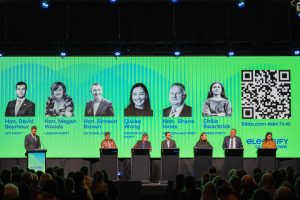
Deputy PM David Seymour, Labour Party leader Chris Hipkins, Energy Minister Simeon Brown, Green Party leader Chlöe Swarbrick, Assoc. Energy Minister Shane Jones and The Opportunity Party leader Qiulae Wong will all take part in The Future of New Zealand’s Energy System: A Leaders’ Debate, at the event on Monday, moderated by Paddy Gower. That line up shows how crucial energy and the cost of living will be for all parties in October’s General Election.
Queenstown has long positioned itself as a leader in tourism innovation. Increasingly, it is also becoming a place where the national conversation around electrification, resilience and regional energy security is being tested in real time.
For many tourism businesses, the question is no longer whether electrification is coming.
It is how quickly they are prepared to move.
Mat Woods
Chief Executive
Destination Queenstown and Lake Wānaka Tourism
Electrify Queenstown 2026, backed by Principal Sponsor Aurora Energy, is being held from 17-19 May at Queenstown Events Centre and locations around the area. More information is available here.

11 Jun 2025 Electrify Queenstown returning in 2026